Citeably · Product owner story
How to get your product recommended by ChatGPT: what 858 AI answers taught us
We asked ChatGPT, Gemini, Perplexity and Claude the questions buyers ask, for 61 real products, and 79% of those sites were never named once. The ones that did get named had three things in common, and none of them need a big budget.
Submitted by a product owner · · Visit Citeably ↗
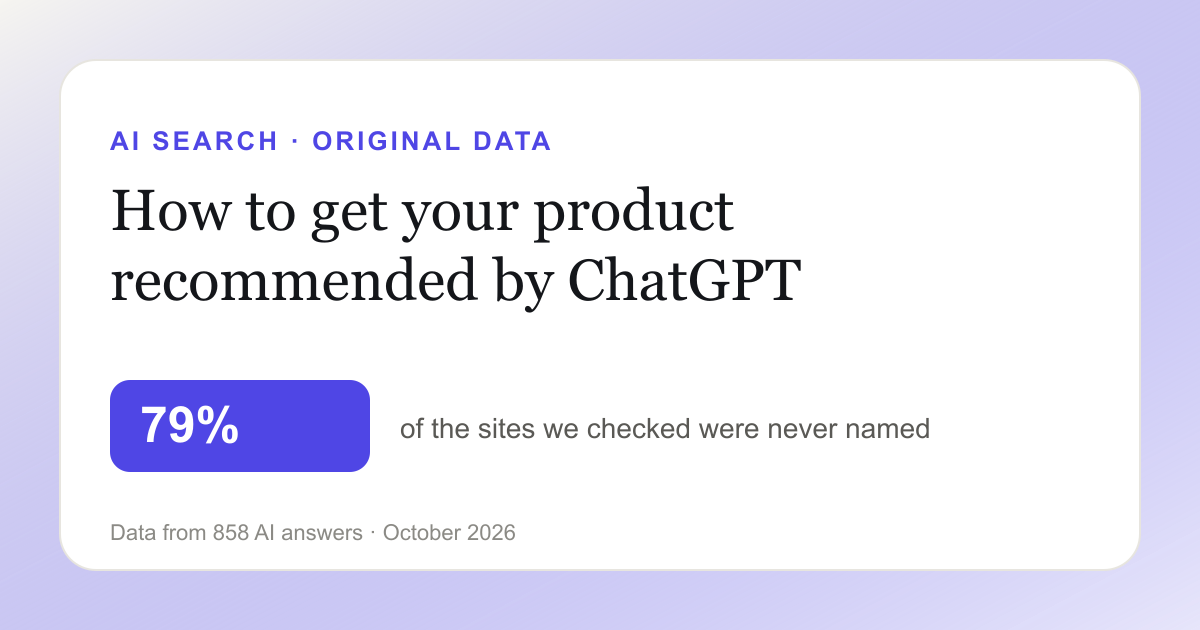
!How to get your product recommended by ChatGPT: 79% of the sites we checked were never named
How to get your product recommended by ChatGPT: what 858 AI answers taught us
Summary: We asked ChatGPT, Gemini, Perplexity and Claude the questions buyers ask, for 61 real products, and 79% of those sites were never named once. The ones that did get named had three things in common, and none of them need a big budget.
Disclosure: this data comes from Citeably, an AI visibility tool built by Uppeek's founder. The numbers are from real checks, shown as they came out.
What we did
Between October 10 and October 28, 2026, Citeably ran AI visibility checks on 61 websites: mostly SaaS products, small B2B companies and a few well-known brands for comparison. For each one, AI assistants were asked the questions a buyer would ask, such as "best testimonial tool for a small SaaS" or "eco-friendly yarn supplier in India", without ever mentioning the brand.
That gave us 858 answers. For each answer we recorded whether the brand was named, where it appeared in the list, who was named instead, and which websites the answer leaned on.
What we found
1. Most products are invisible to AI
- Sites checked: 61
- Answers read: 858
- Answers that named the brand: 61 (7.1%)
- Sites never named in any answer: 79%
If your product isn't showing up in ChatGPT, you're in the majority. That's also the opportunity: in most categories, only two or three brands are winning the answers, and nobody has claimed the rest yet.
2. Specific questions are easier to win than broad ones
Each check asked two kinds of question: broad category questions ("best testimonial tools") and specific ones about what the product actually does ("tool to turn tweets into testimonials").
- Broad category: named in 5.8% of 344 answers
- Specific to what the product does: named in 8.7% of 344 answers
Products were named about 1.5 times more often for the specific questions. Big, established brands win the broad questions. A smaller product wins the questions where it is the clearest answer.
3. When you're named, you're often named first
Of the answers that did name the brand, 51% named it first. AI assistants don't sprinkle names in at random: when your page clearly answers the question, you tend to lead.
4. AI reads your competitors' pages, not yours
We grouped every site the answers cited:
- Third-party pages (articles, guides, lists): 60% of citations
- Competitors' own websites: 32% of citations
- Directories and review sites: 5% of citations
- The brand's own site: 2% of citations
A third of what AI reads in your category is your competitors describing themselves, often in their own "best tools" articles where they rank themselves first. The brand's own site was cited in only 20% of reports.
What the brands that got named did differently
They answer one question per page, in the first two sentences. "Turn tweets into testimonials" as a page title, and the answer in the opening lines. AI quotes the start of a page most.
They're described the same way across the web. The products named most often were described on comparison articles, directories, and Reddit threads, not only on their own site. AI trusts what others say about you more than what you say about yourself.
They say who they're for and what they cost. "For solo founders, free for 10 testimonials, $19/month after" is easy for an AI to repeat. "A powerful platform for modern teams" isn't.
A 30-minute checklist
- Ask ChatGPT and Perplexity the question your buyers ask. Write down who gets named.
- Pick the one specific question where you're the best answer. Make a page whose title is that question.
- Put the answer, your price and who it's for in the first two sentences.
- Find the two or three articles the AI cited, and ask their authors to include you.
- Check again in four weeks.
The caveats
These are mostly small and newer products, so the numbers are lower than they would be for a list of famous brands. Most checks used each assistant's free tier, which often answers without searching the web, especially ChatGPT, which named brands in only 1.4% of its answers here. AI answers also change from run to run, so treat any single result as a snapshot, not a verdict.
Want to see what AI says about your product? Citeably runs this check for free, no signup: citeably.app.