Citeably | AI visibility · Product owner story
How to Track Your Brand's Visibility in AI Search and Recommendations
As buyers increasingly use AI assistants to research products, brands need to understand whether they're being recommended or overlooked. Learn how AI visibility tracking helps you measure brand mentions, compare competitors, and identify opportunities to improve your presence in AI-generated answer
Submitted by a product owner · · Visit Citeably | AI visibility ↗
How to Track Your Brand's Visibility in AI Search and Recommendations
People are increasingly turning to AI assistants to research products, compare software, and find solutions to specific problems.
Instead of searching Google for "best project management software," a potential customer might ask ChatGPT, Perplexity, or Claude:
- What's the best project management tool for a small startup?
- Which alternatives to Asana are worth considering?
- What software should a marketing agency use to manage multiple clients?
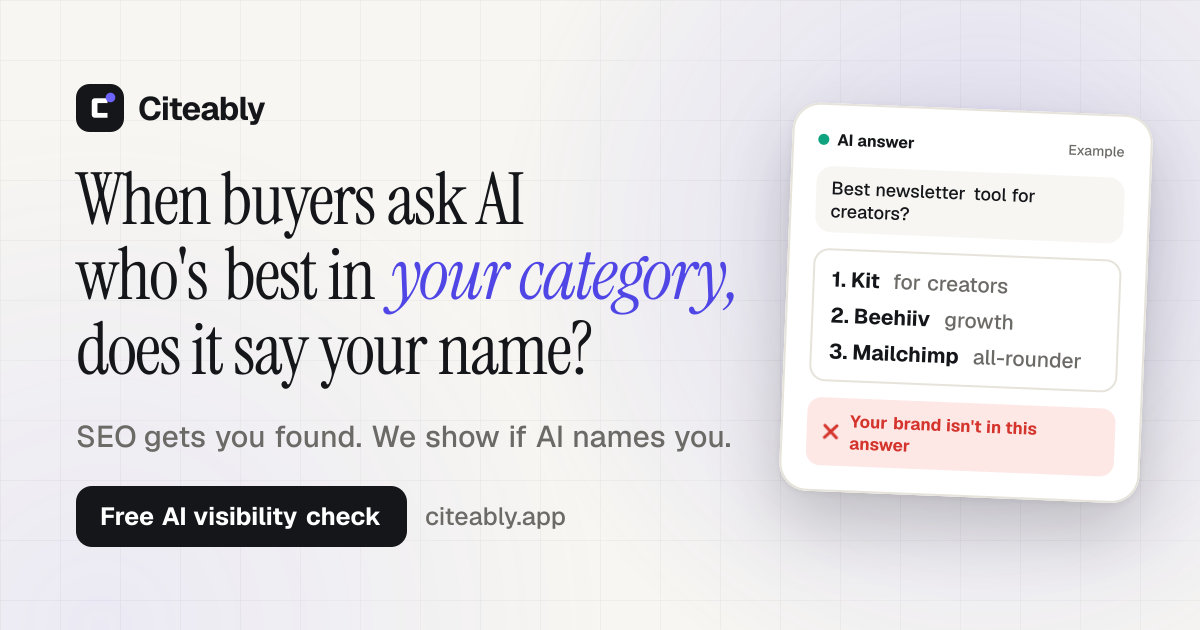
These questions create a new challenge for businesses: Is your brand being recommended when potential customers ask AI for advice?
Traditional search rankings don't fully answer that question. A website can perform well in Google and still be absent from an AI-generated product recommendation.
This is where AI visibility tracking comes in.
What is AI visibility?
AI visibility describes how often and in what context a brand appears in answers generated by AI assistants.
It can include several different measurements:
- Brand mentions: How frequently does an AI assistant mention your product?
- Recommendations: Does the assistant actively recommend your product for a particular use case?
- Competitor visibility: Which competing products appear instead of yours?
- Context and positioning: How does the AI describe your product, its strengths, and its limitations?
- Buyer-question coverage: Does your brand appear for the specific questions your ideal customers ask?
These measurements are related, but they're not interchangeable.
A product might be mentioned in a general overview yet never be recommended when someone asks for a solution to a specific problem. Understanding that distinction is important when deciding what to improve.
Why traditional SEO metrics aren't enough
SEO remains important. Search engines help people discover websites, and the content, authority, and technical quality of a website can influence its discoverability.
However, AI-generated recommendations introduce another layer.
Imagine you run a SaaS product for customer feedback.
Your website may target keywords such as "customer feedback software" and "testimonial collection tool." But prospective customers might ask an AI assistant:
"What's the easiest testimonial tool for an indie founder who wants to collect feedback from social media?"
The answer could mention several competitors without mentioning your product.
A traditional ranking report might not reveal that gap. You need to examine the actual questions and answers to understand how your brand is represented.
How AI visibility tracking works
A practical AI visibility workflow has four steps.
1. Define the questions your customers ask
Start with real buyer questions rather than generic keywords.
For example:
- What's the best CRM for a small B2B startup?
- Which analytics tools are affordable for indie founders?
- What are the best alternatives to a specific competitor?
- Which tools support a particular integration or workflow?
The goal is to understand visibility in the situations where your product could genuinely be a good fit.
2. Test relevant AI assistants
Run those questions through the AI platforms that matter to your audience.
Record whether your brand appears, which competitors are mentioned, and what the answer actually says.
AI answers can vary between runs, so a single result should not be treated as a permanent ranking. Repeated measurements provide a more useful picture of changes over time.
3. Compare competitors and inspect the answers
A visibility percentage is a useful starting point, but it doesn't tell the whole story.
Suppose your product appears in 3 out of 20 relevant answers. A competitor appears in 12 out of 20.
That difference gives you a reason to investigate further.
Look at the original answers. Are competitors described as easier to use? Do they have more detailed comparison pages? Are they associated with integrations or use cases that your website doesn't explain clearly?
These are hypotheses to investigate, not automatic explanations for every missing mention.
4. Turn observations into improvements
Use the findings to identify practical content improvements.
Depending on what the evidence shows, you might:
- Explain your product's core use cases more clearly.
- Publish accurate feature and integration documentation.
- Create useful comparison pages for genuine alternatives.
- Add detailed answers to common customer questions.
- Make pricing, limitations, and eligibility requirements easier to understand.
- Ensure important product information is accessible to search engines and AI crawlers.
The objective isn't to manipulate AI answers. It's to make your product easier to understand and evaluate when it is relevant to a customer's needs.
Meet Citeably: AI visibility tracking for brands
Citeably helps businesses investigate how their products appear in AI-generated recommendations.
Instead of relying only on website traffic or conventional keyword rankings, the idea is to examine the answers themselves: whether a brand appears for relevant questions, which competitors are present, and where visibility opportunities may exist.
For founders, marketers, and agencies, this provides a starting point for understanding how AI assistants represent a product.
A useful report should help answer three questions:
- Where is our brand already visible?
- Where are competitors being recommended instead?
- What can we investigate or improve to close the gap?
AI visibility tracking is still an evolving practice. Results depend on the questions tested, the AI platform, and when the measurements are taken. No tool can guarantee that an AI assistant will recommend a particular brand.
The value is in measuring consistently, inspecting real answers, and using the evidence to guide better decisions.
Who should care about AI visibility?
AI visibility can be worth investigating if you are:
- A SaaS founder trying to reach buyers who research software through AI assistants.
- A marketing or SEO agency looking for additional ways to measure how clients appear in AI-generated answers.
- A product marketer monitoring how AI describes your product against competing solutions.
- A growing business trying to understand whether its online content communicates its value clearly.
You don't need to abandon SEO to explore AI visibility. The two can complement each other.
Final thoughts
As AI assistants become another way people research products, businesses need ways to understand what those assistants say about them.
Traffic tells you who visits your website. Search rankings tell you where pages appear in search results. AI visibility tracking investigates another question: When a potential customer asks an AI assistant for a recommendation, does your product make the list?
Start with a small set of genuine buyer questions, inspect the answers, compare the alternatives, and repeat the measurements over time.
To explore AI visibility tracking, visit Citeably.app.